


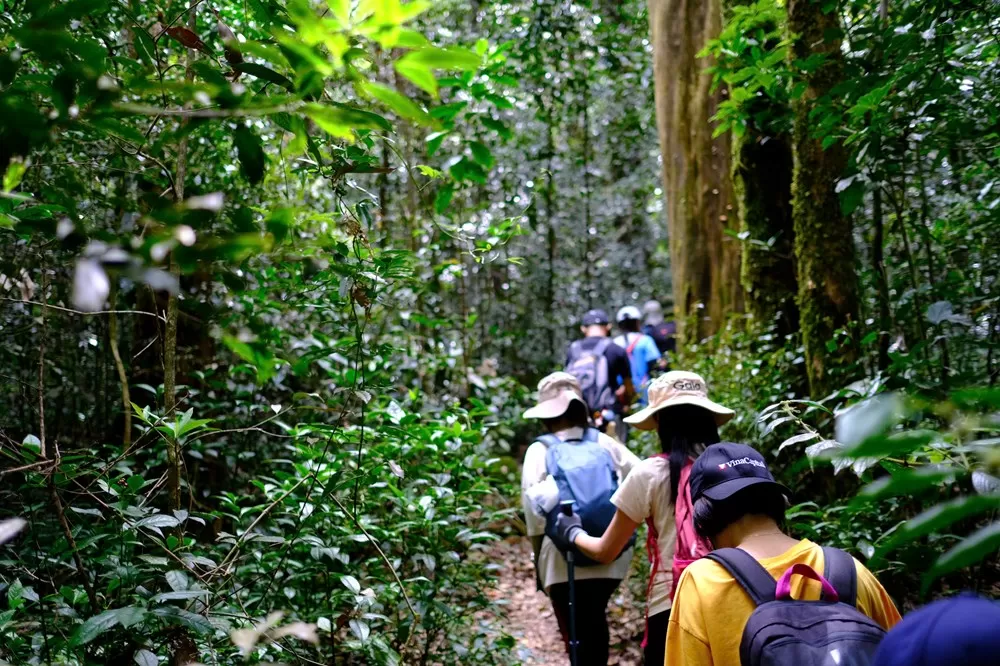
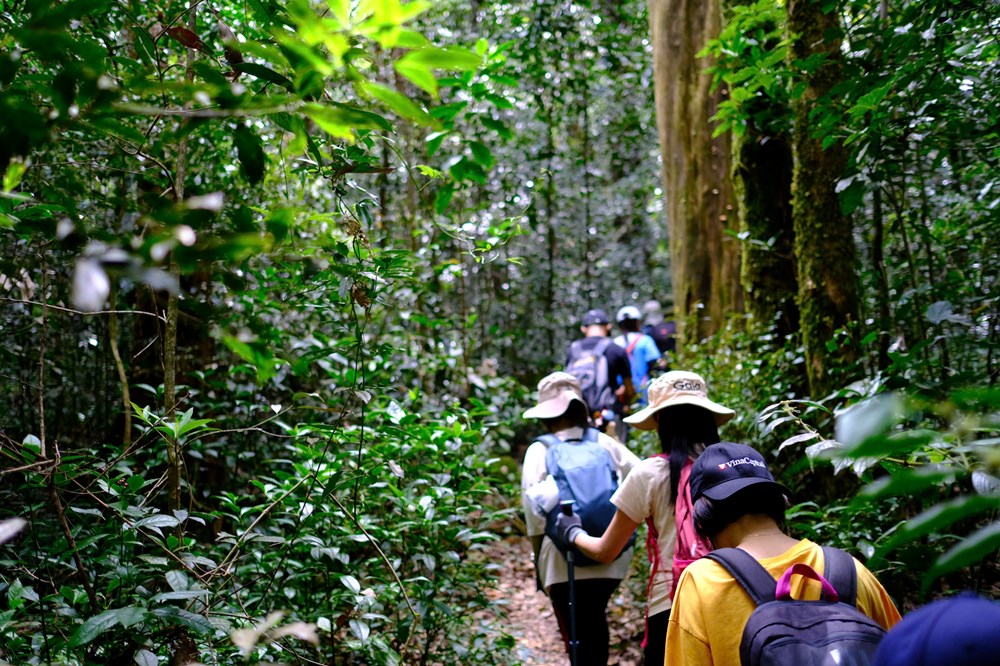
Bidoup - Nuí Bà National Park possesses great potential for developing forest ecotourism.
Vietnam's leading biodiversity center.
Bidoup - Nui Ba National Park was established in 2004, its name derived from the combination of two peaks: Bioup, 2,287m high (the highest in Lam Dong province), and Nui Ba, 2,167m high.
Bidoup – Nuí Bà National Park is currently located within the administrative boundaries of Lac Duong commune, Langbiang ward - Da Lat and Dam Rong 4 commune of Lam Dong province, occupying almost the entire Lang Biang Plateau (also known as Lam Vien Plateau). In addition, the park borders the provinces of Dak Lak and Khanh Hoa.
Bidoup - Nuí Bà National Park is considered to have one of the highest levels of biodiversity in Vietnam.
With an area of over 70,000 hectares, Bidoup - Nuí Bà National Park is located in the core zone of the Lang Biang World Biosphere Reserve, recognized by UNESCO in 2015, and is also one of 34 national parks in Vietnam's system of special-use forests.
91% of Bidoup - Nuí Bà National Park's area is covered by forest and forest land, primarily primary forest. The primary forest ecosystem here is considered to have one of the highest levels of biodiversity in Vietnam, with thousands of plant and animal species, many of which are endemic and rare, listed in the Red Books of Vietnam and the world.
According to surveys and records, there are currently 1933 species of vascular plants in Bidoup - Nui Ba National Park, including 62 rare species distributed in 29 different plant families, classified in the Vietnamese Red Book of rarity levels such as red pine, green cypress, fir, Da Lat five-needle pine, flat two-needle pine, etc.
Regarding narrowly endemic species, 91 species with limited distribution in Lam Dong and surrounding areas have been cataloged, with 28 species being Latinized. Bidoup - Nui Ba National Park is also considered the kingdom of Vietnamese wild orchids, with over 250 species.
A 1,300-year-old ancient cypress tree was discovered here.
In terms of fauna, this area is home to 56 species listed in the catalog of rare animals. Of these, 47 species are listed in the Vietnam Red Book, and 30 species are listed in the IUCN Red Book, such as the slow loris, black-footed langur, red-cheeked gibbon, sun bear, clouded leopard, elephant, red wolf, gaur, serow, tiger, etc.
The rich vegetation and diverse fauna have created a valuable "natural laboratory" for scientific research, environmental education, and sustainable tourism development.
In the Trường Sơn mountain range ecosystem conservation program, the Bidoup – Núi Bà area is also identified as being within the main mountain massif of the Southern Trường Sơn range and is the top priority area for conservation (SA3 area).
Advantages for developing forest ecotourism and nature exploration.
In the context of global tourism shifting strongly towards green, sustainable, and nature-based experiences, national parks and nature reserves are increasingly asserting their strategic role and advantages in many localities across the country, including Bidoup - Nuí Bà National Park in Lam Dong province.
Mr. Pham Van Dan, Deputy Director of Bidoup - Nui Ba National Park, assessed that Bidoup - Nui Ba National Park has enormous potential in attracting tourists and developing types of tourism that explore forest habitats, natural landscapes, and biodiversity. This is the foundation that creates a difference compared to urban or purely resort tourist destinations.
In addition, the park has the potential to develop cultural tourism, as it is one of the oldest residential areas of ethnic minority communities of the Central Highlands, primarily the K'Ho people.
Bidoup - Nui Ba National Park has strong tourism potential in activities such as nature exploration, trekking, and mountain climbing.
Unlike bustling traditional tourist centers, Bidoup - Nui Ba attracts visitors with its pristine beauty and pleasant climate year-round. Average temperatures range from 18-22°C, creating ideal conditions for trekking, mountain climbing, camping, and exploring nature.
In 2024, the People's Committee of Lam Dong province officially recognized the "Bidoup - Nui Ba National Park" as a tourist destination and assigned the Tourism and Science Service Center of Bidoup - Nui Ba National Park as the unit directly managing it, responsible for fully complying with all relevant legal regulations in the process of managing and exploiting tourism business at this tourist destination.
According to Mr. Dinh Van Ty, Deputy Director of the Tourism and Science Service Center, "Currently, the Center is collaborating with many tourism businesses in the area to organize tours to bring visitors to the Garden."
Here, visitors can choose one of two tours, day or overnight, with itineraries exploring several typical routes such as: the Thien Thai Waterfall route, the biodiversity route, and the Bidoup Peak route.
Tourists check in at the rare cluster of red pine trees in the park.
One of the highlights of the route is the journey to conquer Bidoup Peak, 2287 meters high – known as the "roof of Lam Dong". From here, visitors can enjoy panoramic views of the rolling mountains and forests, clearly feeling the grandeur of the plateau.
In addition, tourist routes such as Thien Thai Waterfall, the ancient cypress forest, and the K'Ho community cultural exchange route are also being developed with a focus on controlling visitor numbers and ensuring a balance between conservation and development.
Environmental education tourism is one of the signature products here, with experiential programs for students that help raise awareness about biodiversity conservation, climate change adaptation, and sustainable development.
Environmental education tourism is also receiving special attention.
Developing forest-based ecotourism while creating livelihoods for local communities is also one of the key directions of the Bidoup - Nuí Bà National Park management board, especially for the K'Ho ethnic minority living around the buffer zone. Homestay models, local guides, introductions to local culture, and traditional handicrafts are gradually creating stable livelihoods and reducing pressure on forest resource exploitation.
Mr. Pham Van Dan stated that, in recent times, tourism activities at the park have always involved local ethnic minority households in the area, participating in tour guiding, setting up activities along the route, and introducing local culture.
Local cultural elements are incorporated into tourism development.
“This approach aligns with the trend of responsible tourism, where local cultural values are preserved alongside ecosystem protection. Instead of mass exploitation, Bidoup - Nui Ba chooses a strategy of ‘quality over quantity,’ targeting the segment of nature lovers, researchers, photographers, and those seeking controlled adventure tourism,” Mr. Dan emphasized.