


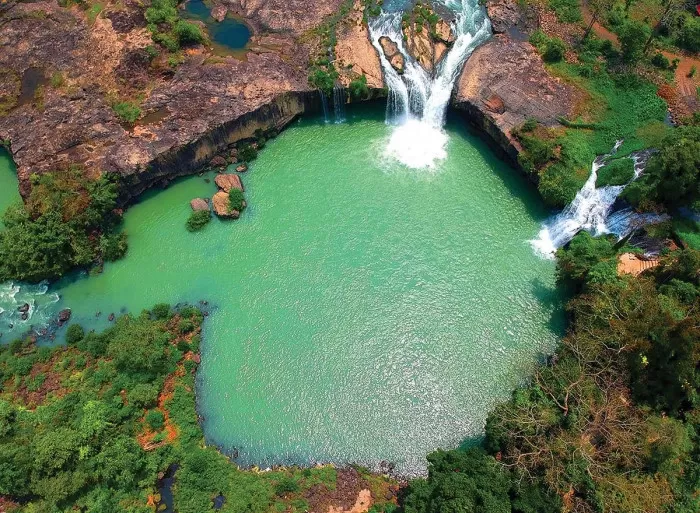
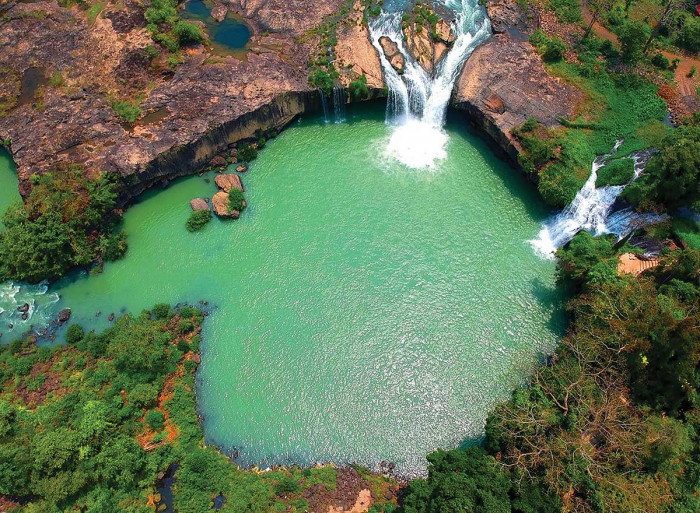
A symphony of fiery land and a river flowing backward.
Right from the road leading up to Dray Sap waterfall, the vast forest unfolds into an enchanting landscape. Winding curves between rows of towering green pines resemble soft silk ribbons draped across the mountainside. Wildflowers bloom along the way, the earthy scent of plants and trees mingles in the early morning breeze, and the sudden showers of the highlands and the lingering mist create an even more mystical atmosphere.
In the morning, clouds blanket the mountain slopes, mist clings to the branches and even the eyelashes of travelers. The air is so clear and pristine that one longs to reach out and touch the tiny droplets of water vapor hovering before them. Amidst this scene, one easily wishes time would slow down to immerse oneself in the poetic beauty of nature and temporarily set aside daily weariness, before the roar of the waterfall echoes like an awakening from the vast forest.
Amidst the vast expanse of red basalt soil, beside coffee plantations stretching to the horizon, Dray Sap emerges like a vertical wall of water in the heart of the forest. The waterfall cascades down in a powerful, white torrent, reflecting the vibrant energy of the mountains and forests. The sound of water crashing against rocks and echoing against the cliffs carries hundreds of meters, creating an unending symphony of the green forest.
Dray Sap Waterfall is located in Nam Ha commune, Krong No district, former Dak Nong province (now part of Lam Dong province), on the legendary Serepok River. Since 1993, Dray Sap has been recognized as a national scenic spot. This designation is not merely a tourist gimmick, but an acknowledgment of the exceptional landscape, geology, and cultural value of a land formed by the earth's violent movements.
According to local guides, Dray Sap was formed by the subsidence of geological plates, creating a valley that cuts across a major river. The basalt flow from the Nam Blang volcano, erupting over millions of years, has left clear traces. The lava flowed slowly, gradually cooled, and naturally contracted, creating characteristic columnar basalt rock formations. Along the waterfall area, various forms of foamy basalt and signs of ancient flow can be observed, like a stone chronicle of the vast forest.
The waterfall is approximately 20 meters high and nearly 100 meters wide. This width allows the space to open up horizontally, creating a vast and expansive area. Dray Sap doesn't soar vertically like many other waterfalls, but instead displays its power horizontally, creating an overwhelming feeling with the spreading of water and mist.
In particular, Dray Sap is the final stretch of the Serepok River, which flows upstream. This "reverse flow" has become a geographical legend of the Central Highlands. During the dry season, the water at the top of the waterfall is sometimes only ankle-deep. Visitors can walk barefoot across the smooth basalt rocks, feeling the gentle current flowing between their toes and listening to the gurgling sound of water beneath the ancient, millions-of-years-old rocks.
The name Dray Sap in the Ede language means "smoke waterfall," where Dray means waterfall and Sap means smoke. The name originates from the image of the cascading water creating a fine mist of water droplets, like mist, lingering throughout the area. Year-round, the entire region is immersed in the roaring sound of the waterfall and a hazy, dreamlike veil of mist.
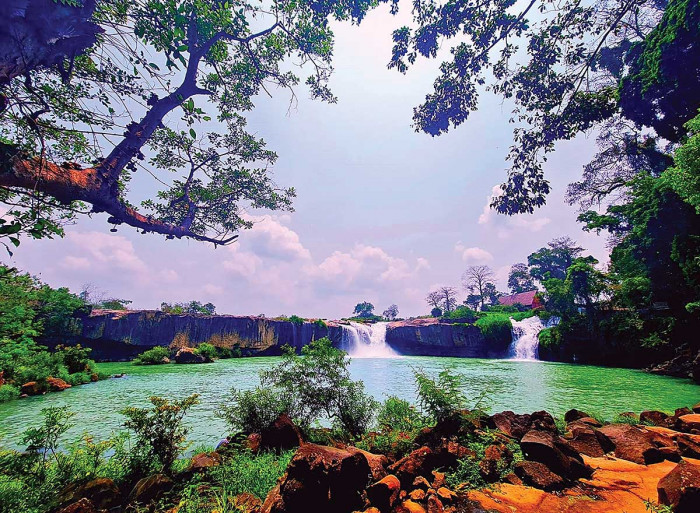
The legend of love turned into smoke and water.
If geology shaped the body of Dray Sap, then legend breathes life into it. The M'Nong and Ede people still tell the story of a young couple deeply in love but forbidden from being together by their families. In despair, they threw themselves into the rocky, upstream-flowing river to be together forever. From then on, the Serepok River split into two branches. One branch flows towards Krong No, meaning the male river. The other flows towards Krong Ana, meaning the female river. The male branch of the river created Dray Sap waterfall. The female branch created Dray Nur waterfall. The locals call the two waterfalls the Husband waterfall and the Wife waterfall, as a symbol of faithful devotion.
Another legend tells of an Ede girl named H'Mi. When her husband fell seriously ill, H'Mi went deep into the forest to find medicinal leaves to save him. Even though she bit her finger and fed her blood to her husband, fate was cruel. Her husband breathed his last in her arms. H'Mi wept incessantly for many days and nights. Her cries echoed to the spirits. Mourning this tragic love, the spirits created the waterfall to commemorate the woman's virtue. The cascading water symbolizes H'Mi's tears, and the name "Smoke Waterfall" was born from that. This legend adds to the mystical atmosphere, imbued with the epic spirit of the Central Highlands.
In fact, Dray Sap is a system of three waterfalls. The Serepok River, flowing from upstream, divides into three tiers. Besides the main waterfall, on the other side of the river is Dray Nu waterfall, about 12 meters high, with two streams of water flowing amidst a majestic landscape. About 100 meters away is another large waterfall in the system, 12 meters high but 140 meters wide, always spraying fine water mist like smoke.
Crossing the suspension bridge, visitors enter a high, airy area like an oasis nestled between two waterfalls. From here, one can take in the entire Dray Sap and Dray Nu waterfall system, feeling the harmonious blend of ferocity and gentleness, the roaring sound of the water and the endless green of the ancient forest.
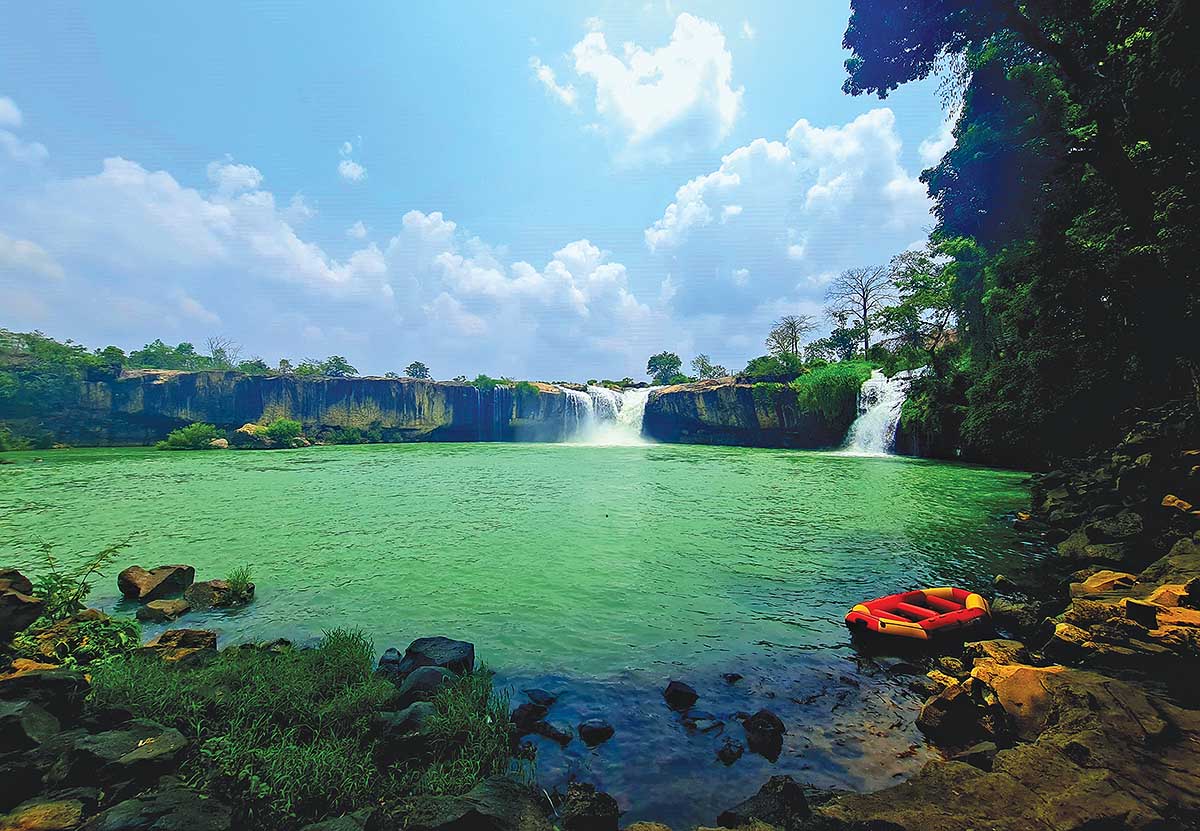
A strategic connecting point for tourism in the Central Highlands.
Dray Sap is not static in its appearance. The waterfall changes shape and color with the rhythm of the earth and sky. From May to October, the rainy season brings its most powerful appearance. Water from the upstream rushes down, crashing against the cliffs in a white foam; mist rises high and spreads in the cool air. Under the sudden sunlight, delicate rainbows appear amidst the mist.
When the dry season returns, from November to April of the following year, Dray Sap becomes much gentler. The flow calms down, revealing basalt rock formations and geological strata marked by time against the deep blue sky. This is also the season when flocks of colorful butterflies flutter about, their movements under the golden sun adding a touch of serenity to the already turbulent landscape.
The path leading to the waterfall unfolds like a gentle transition of scenery. Moss-covered stone bridges, pools of water as clear as jade; sunlight filters through the canopy of ancient trees and falls on smooth, rounded stones polished by the passage of time. The deeper you go, the quieter the forest becomes. The occasional bird song pierces the air before fading into the foliage. A few squirrels dart nimbly from branch to branch high above, full of life.
At the foot of the waterfall, strangely shaped rock formations are stacked upon each other, creating a robust structure for the landscape. Following the cliff to the top, a crystal-clear stream appears, revealing even the pebbles lying at the bottom. In the scorching heat of the plateau, immersing oneself in the cool water, listening to the sound of water cascading against the rocks, mingled with the rustling of forest leaves and the chirping of cicadas, is an experience that will be remembered for a long time.
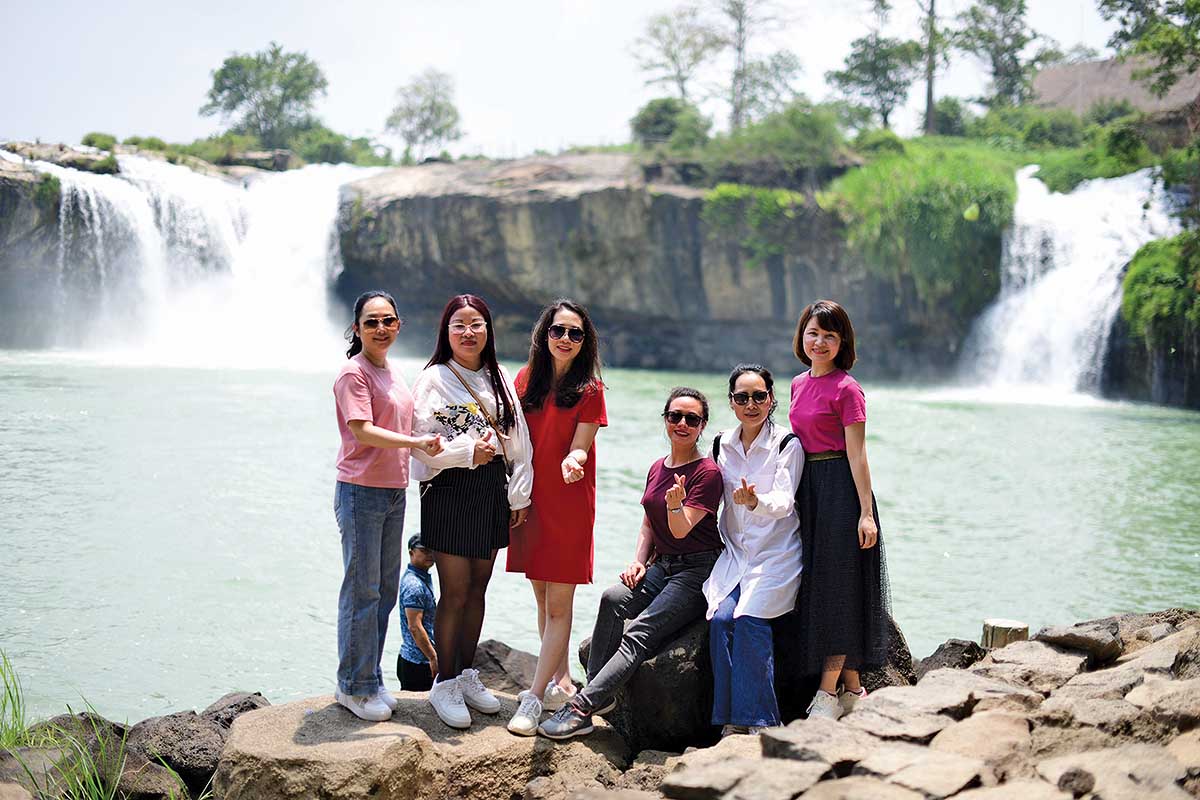
During the autumn leaf-falling season, the beauty of Dray Sap takes on a different hue. The landscape is tinged with a dry, golden color. The slender tree trunks cast shadows beside the steadily flowing waterfall, creating a contrast between stillness and movement, between dryness and abundance. It is in this contrast that the enduring vitality of the Central Highlands' nature is revealed more clearly than ever before.
Located in the western part of Lam Dong province, amidst the M'nong plateau – a region that embodies the outstanding values of the UNESCO Dak Nong Global Geopark – the journey from the anchor point of Dray Sap extends to Lieng Nung, Ta Dung National Park, and Nam Nung Nature Reserve, forming a continuous experiential axis between geology, ecology, and indigenous culture. Within this structure, Dray Sap is gradually asserting its role as the core of a network of unique destinations in the western plateau, where nature and sustainable tourism development strategies can go hand in hand.
Leaving Dray Sap, one carries with them not the noise, but a silence. The silence of million-year-old basalt rocks, of the persistent Serepok River flowing upstream, of legends still echoing in the forest breeze.