


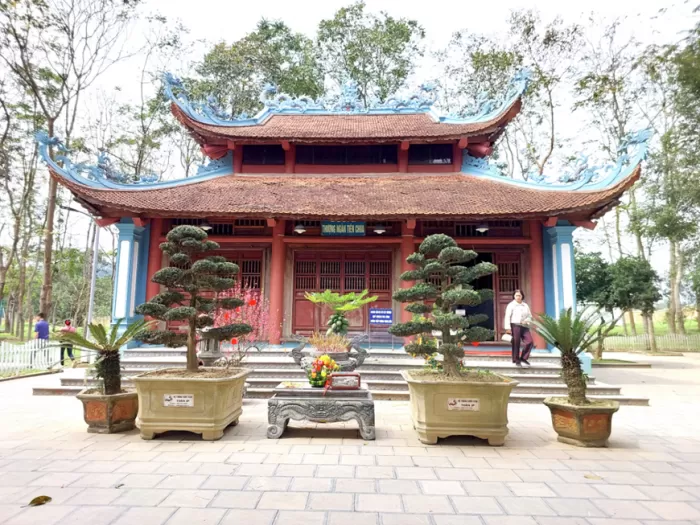
Traveling in the opposite direction on the Noi Bai - Lao Cai expressway, exiting at the IC14 interchange, and continuing for about 15km, visitors will arrive at Ben Den village, Dong Cuong commune (Lao Cai province).
Along the road to Dong Cuong, towering mountains cast their reflections onto the Red River, its waters heavy with red silt. Plum and peach blossoms burst forth on either side of the road, displaying their vibrant colors. In the distance are peaceful villages nestled beside rice paddies, their young shoots shimmering in the golden hues of the seedlings. Particularly striking are the rolling hills, covered in the lush green of cinnamon trees.
This region has long been the largest cinnamon granary in Northwest Vietnam, with the fragrant cinnamon of Van Yen and Dong Cuong spreading far and wide. The deeper you travel along the Dong Cuong road, the more distinct the colors of this land become, blending with the vibrant spring atmosphere that permeates every corner, creating a picturesque spring scene in this mountainous highland region of Northwest Vietnam.
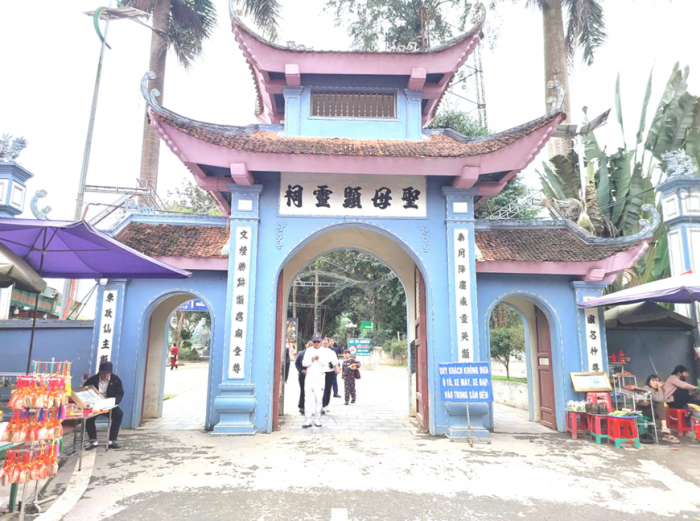
The triple gate of Dong Cuong Temple - the place that leads visitors into the spiritual space of Dong Cuong Temple.
The Dong Cuong Mother Goddess Temple, a National Historical and Cultural Monument, has long been a space for the convergence and dissemination of the Vietnamese people's belief in worshipping the Mother Goddess of the Mountains, making an important contribution to the preservation and promotion of the value of the intangible cultural heritage of humanity, "The practice of worshipping the Mother Goddess of the Three Realms by the Vietnamese people".
The temple is situated in a "gathering of wind and water" position, surrounded on the right by a crescent-shaped stretch of river where the gentle Red River flows, and in the distance, rolling mountains create a picturesque landscape. In front of the temple stands an 800-year-old banyan tree casting its shade over the ancient temple, evoking the timeless charm of the sacred land of Dong Cuong.
According to historical records and folk tales, the Goddess of the Mountains worshipped at the Dong Cuong Temple was originally Princess La Binh, the daughter of Son Tinh and My Nuong. Princess La Binh was a beautiful, virtuous, hardworking young woman who lived in harmony with nature and people. La Binh always accompanied her father on his travels to govern the mountainous regions and streams of the highlands, admiring the vast, lush green forests with their fragrant flowers and sweet fruits. Wherever she stopped, Princess La Binh taught the people how to cultivate rice and fruit trees, and how to establish mountain villages and houses. Later, when Son Tinh and My Nuong ascended to heaven and became immortal, Princess La Binh was bestowed the title of Princess of the Mountains, taking on the responsibility of governing the mountainous region.
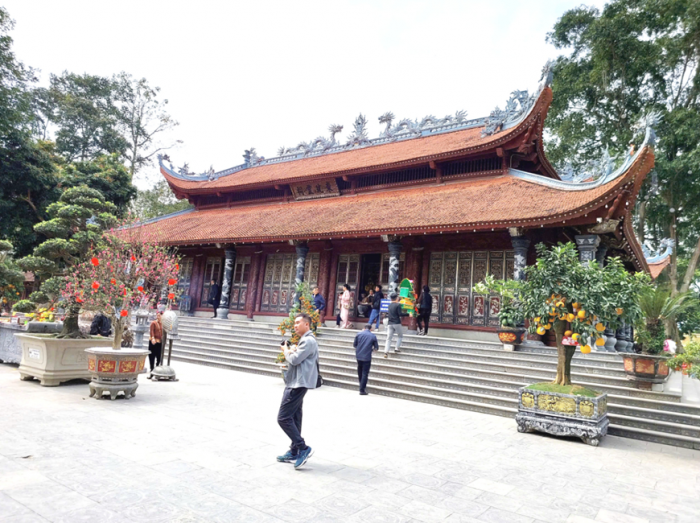
Visitors from all over the country choose Dong Cuong Mother Goddess Temple as their spring travel destination at the beginning of the year.
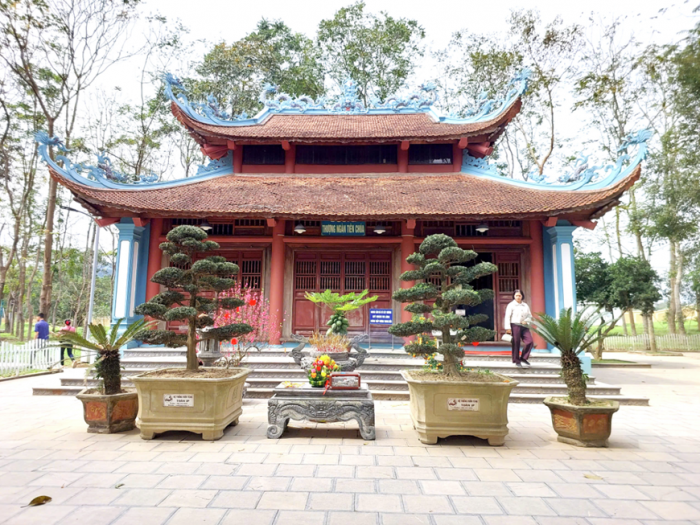
The spiritual space dedicated to the Mother Goddess of the Mountains in the Northwest region evokes the distinctive colors of the temple.
The Dong Cuong Mother Goddess Temple is also a place of worship and remembrance of the meritorious deeds of local ethnic minority leaders who made great contributions to the resistance against the Mongol-Yuan invaders, such as Ha Dac, Ha Chuong, Ha Bong, etc. The architecture of the Dong Cuong Mother Goddess Temple is distinctly ancient, reflecting the practice of the Vietnamese Mother Goddess worship. The Dong Cuong Mother Goddess Temple complex includes harmoniously arranged temples such as the main temple, the shrine of the Goddess, the shrine of the God, the mountain cave, the shrine of the spirits, and the shrine of the Venerable Lord...
The temple is built in a T-shaped structure consisting of two parts: the main hall and the sanctuary. The main hall is the space where visitors from all over come to worship and offer prayers, and also the place for practicing the worship of the Mother Goddess of the Mountains. The temple still preserves and worships the statue of the Second Mother Goddess of the Mountains, the statue of the high-ranking official Dai Vuong of the Tay Khao ethnic group (locally known as Quang Hoang Bao), and many ancient statues and precious artifacts. Dong Cuong Temple was recognized as a National Historical Monument by the Ministry of Culture, Sports and Tourism in 2009, and the Dong Cuong Mother Goddess Temple Festival was recognized as a National Intangible Cultural Heritage in 2023.
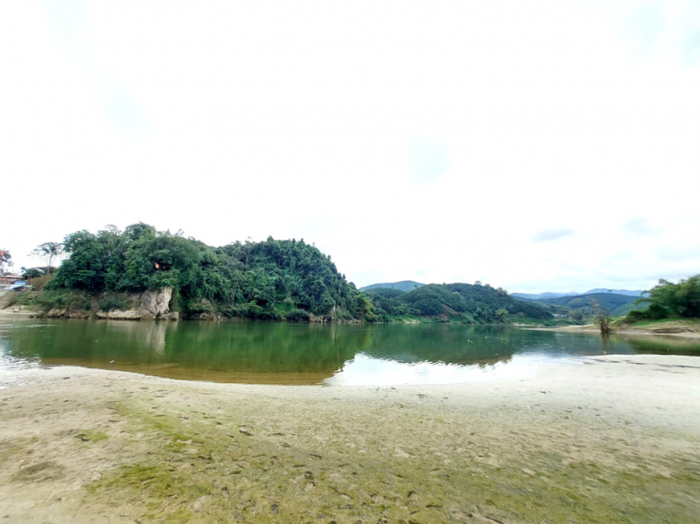
A stretch of Dong Cuong landscape, a characteristic mountainous region.
As spring arrives, visitors from all over flock to Dong Cuong Temple to celebrate, participate in festivals, worship, and pray for good fortune and wealth. Stopping at Dong Cuong Temple, visitors will experience the unique colors and sounds of the Chau Van and Hau Dong rituals performed by skilled artisans and mediums.
From the ancient Dong Cuong temple, the worship of Mother Goddess Thuong Ngan has spread not only to temples in the Northwest region but also to many temples in the plains and midlands of Northern and Central Vietnam. In these temples, Mother Goddess Thuong Ngan is worshipped with reverence and sacredness, expressing the gratitude and appreciation of the Vietnamese people towards this mythical Mother. From there, the worship of Mother Goddess has naturally become an integral part of Vietnamese life, carrying profound humanistic values.
Amidst the vibrant spring colors that fill the land of Dong Cuong, people's hearts are uplifted and joyful as they immerse themselves in a spiritual realm, reflecting on the merits of their ancestors who served the nation and were virtuous to the people. In the harmony of nature, of the divine, and of the people, each individual seems to cast aside worries, finding inner peace and living slowly amidst the landscapes of Northwest Vietnam.